I passed the British Canoeing advanced qualifications of Stand Up Paddleboard Coastal Leader and SUP Open Water Coach Award. Here’s some notes for my own interest and anyone else’s.
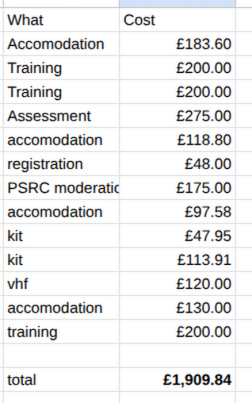
I did Coastal Leader training twice (once had a second day cancelled because the weather was too good). This gave me experience of a range of conditions including getting blown out to the atlantic once (we got stuck on a rock called Goat Island and had to paddle hell for leather two on a board into land to end up several miles from the cars). I did Open Water Coach training (two days). I used cheap B&B and AirBNB for these (I like car camping but not in winter and having a toilet to use is pretty invaluable). I did an RYA VHS SRC licence for the radios. I also did a marine navigation course (RYA Day Skipper syllabus). I bought a load of lights, high vis jackets, dry bags and other kit. You have to pay Paddle Scotland to register. With travel at a laughable 45p per mile and the final assessment total costs were about £2800. Erk.
Paddleboarding as a practice will have been done for centuries but as a sport developed out of the safety borders from surf competitions early this millenium. I first did it in 2014 at the SCA CVC and since then I’ve raced on the Nile with Dane Jackson and Bren Orton (I did not win), raced with Kayak Sessions magazine on the durance in France, brought it to Edinburgh at the Canal Festival, paddled around Marina Del Ray in Los Angeles and at Barceloneta in Barcelona. Now that qualifications exist from British Canoeing (who are still called British Canoeing Awarding Body despite their parent organisations all renaming to Paddle) organisations like the Scouts need people to get them, but for the moderate and advanced awards there’s very few providers (3 in Scotland now) and no scheduled courses get run so you need to talk to the providers and schedule them. Scheduling Leader and Coach training and assessment needs to be coordinated not just with you, the provider, kit and venue but exactly the wrong sort of weather with the necessary force 4 (20km/h+) winds. This can mean chasing the wind around the country on the day to find a venue or as-often-as-not cancelling.
Touring boards are usually 12ft 6inches long and narrower than the default options but they are needed for both these awards. You’ll also need to bring dry bags with food, spare clothes, first aid, shelter, pump and water. These awards are considered advanced awards but are in moderate water, this is because a paddleboard is twice the effort for half the result compared to a kayak. But paddleboards do give a full all-body workout and you get a better view.
You need at least three students on the leader assessment and they all need reasonable kit including lights and high vis bits because you need to paddle after dark. It turns out sunset isn’t dark, that is civil twilight, then there’s nautical twilight and astronomical twilight and night. I used paper OS maps and compass on the water but also my phone subscription to OS Maps, Imray Tides and Imray Navigator to get the data on the tidal flows and shoreline, so a waterproof phone is important, as is washing out the phone when it gets salt water on it.
Coastal Leader I led some 3 people from North Queensferry to Dalgety Bay but we ended up with force 4-5 winds which is above remit, everyone got exhaustion and evacuated before the end, which was fine. I also did a night paddle under the Forth bridges (which surely could be a money maker somehow).
The Open Water Coach Award can be done on inland and sea environments, although it doesn’t say that anywhere. I did some paddling around South Queensferry in Force 4 winds. For the main assessment we went inland to Loch Ore Meadows in Fife, I had two students and got one to pass on his wisdom to the newer one looking at balance and forward paddling. It turns out people also need to know how to turn and so I added that in before the end. I did some peer coaching between them. Some IDEAS direct instruction. Some go-and-experiment type questioning and a small journey.
There’s a lot of paperwork to read with the Coach Award, find an office printer to print it off and get reading, almost all the answers to what you need to do are in there even if they’re in Appendix table 3 at the end of the 4th document.
You do need to register in good time and do the check-in (which is just the same as registering and Paddle Scotland still hasn’t accepted mine so maybe it was all for naught). You also need to schedule a couple of evenings for the eLearning which has lots of good stuff in it but it’s easy to lose interest so try to stay focused and take notes and look up the topics afterwards. You need to write a wee essay and log book which takes me back to school and maybe that’s no bad thing.
Thanks to Matt Haydock (branding in transition) and Jess Philip (Dipper Paddleboard) and Donald MacPherson (Explore Highland) for training and assessment.
Thanks to Longcraig Scout centre for kit and facilities and SE Scouts for funding and motivation.